
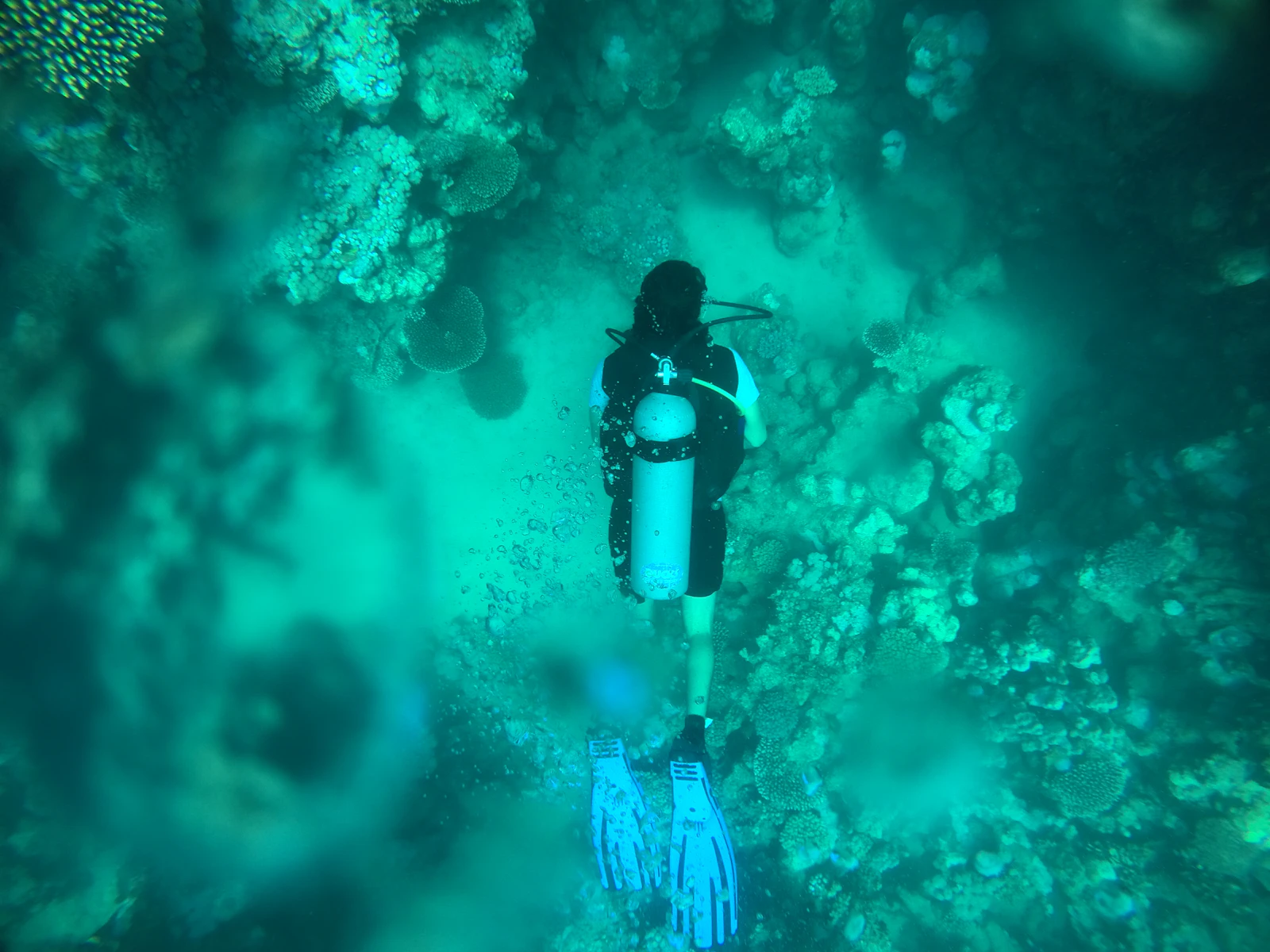
Dive center SEO is the work that gets a dive centre found when divers search on Google, Google Maps and AI assistants, and turns those searches into booked dives and courses. In Sharm El Sheikh it comes down to four things: a complete Google Business Profile, a page for every dive site and course in your divers' languages, a steady flow of genuine reviews, and a clear path from the first page a diver reads to a paid PADI or SSI course.
Key points
- Divers search for places and courses by name: Ras Mohammed, the Thistlegorm, Tiran, "PADI Open Water Sharm". Each deserves its own page.
- Your Google Business Profile is the shop window for guests already in Sharm.
- Reviews after every dive day, answered in the diver's language, build ranking and trust.
- Many students do the theory at home and the dives on holiday. Write pages for them.
- Track bookings by source to see which pages pay.
Why dive center SEO is different in Sharm El Sheikh
Some divers plan months ahead from home. Others decide in the resort, on a phone. Both search in their own language, and both search for specifics: a Russian diver for a Thistlegorm day trip, an Italian family for a try dive for a 10-year-old.
Broad searches are hard to win. When we checked in November 2026, a search for diving in Sharm El Sheikh showed mostly marketplaces and directories, with only one local dive centre's own website. Specific searches are where your site can compete.
Google says local results depend mainly on relevance, distance and prominence, and nobody can pay to rank higher. Our local SEO checklist for Sharm covers the basics; this guide covers what is different for a dive centre.
| What divers search | The page that answers it |
|---|---|
| A dive site: "Thistlegorm day trip" | One page per dive site, per language |
| A course: "PADI Open Water Sharm" | One page per course |
| A first try: "try dive Sharm for kids" | A beginners' page with ages, safety and price |
| A centre nearby: "dive centre near me" | Your Google Business Profile |
Set up your Google Business Profile for a dive centre
For guests already in Sharm, your Google Maps profile is often the first thing they see. Google's Business Profile guidelines apply as for any business, but some points matter more for dive centres.
Choose the right category and name
Google asks you to pick the specific primary category that best describes your main business. Add a few extra categories only for services you really offer, such as snorkelling trips. Use the name on your sign: Google doesn't allow extras such as "Best" or "near Naama Bay" in the name, and breaking this can get a profile suspended.
A dive centre inside a hotel
Many Sharm dive centres work from a hotel beach. Google's guidelines say separate businesses at one location, such as a restaurant inside a hotel, should each have their own profile. So a centre with its own name and team can have its own profile, with the pin on the dive centre, not the hotel lobby. Only one profile per business is allowed, so check that a former manager hasn't made one already.
Add services, prices, a booking link and photos
List try dives, courses, day trips and equipment rental as services with prices. Google lets you add booking and reservation links and choose a preferred one, so link straight to your booking page or WhatsApp.
Upload real photos of the centre, the boat, the equipment, your team (with their OK) and your own underwater shots. Our guide to dive center social media covers using guests' footage with permission.
Build a page for every dive site, in every language
Many dive centre websites have one "Dive sites" page with a paragraph per site. A diver searching for one site in Russian never finds it.
Give each site you visit its own page: Ras Mohammed, Shark and Yolanda Reef, the Thistlegorm, Tiran, Jackson Reef and your house reef. Write each page in the languages your divers read, publish every language on its own page, and connect the versions with hreflang tags so Google can show Russian searchers the Russian page.
| Section of the page | What to write |
|---|---|
| Overview | Where the site is from your jetty, and how long the boat ride takes |
| Level | The certification you ask for, and the depths you usually dive there |
| What divers may see | Reef life, wreck features, currents and best months, from your own logbooks |
| The trip | Which day trip includes it, number of dives, lunch, group size |
| Rules and fees | Park entry and rules, checked with the park authority before publishing |
| Price and booking | The price and what's included, then WhatsApp and booking buttons |
| Proof | Your own photos and video, plus reviews that mention this site |
Write from your own experience: Google says first-hand content stands out against generic text anyone could write. Machine translation is a start, but have a native speaker check every page.
Course pages that turn visitors into PADI and SSI students
A beginner wants to know: am I old enough, fit enough, and safe with you?
Answer the entry questions on the page
PADI's Open Water Diver page sets out the basics. Students must be 10 or older (10 to 14-year-olds earn a Junior Open Water Diver certification), pass a swim and float test, and complete a medical questionnaire, with a doctor's sign-off if a condition is flagged (PADI, 2026). Put each course's requirements on its page, in every language, so families can check before they write. For SSI courses, use SSI's current requirements.
Write for students who did the theory at home
PADI says students can do the eLearning at home and finish the in-water training on holiday, either all of it or only the open water dives. So write a page such as "Finish your PADI Open Water in Sharm El Sheikh": what to bring, how many days it takes and how to share the eLearning record. SSI also offers online training through its MySSI app.
Keep your centre listings consistent
Divers also use PADI's and SSI's centre locators, so keep your name, address, phone and website there exactly as on Google. Google's list of Things to do connectivity partners includes PADI and booking systems such as Bokun, FareHarbor and Rezdy: ask yours whether it can show your trips on Google for an operator in Egypt.
Reviews: a dive centre's strongest signal
Divers trust other divers, and Google says more reviews and positive ratings can help your local ranking.
- Ask on the day. Back at the jetty, after a good dive, hand over a QR card or send your review link on WhatsApp.
- Never pay for reviews. Google says offering free or discounted services in exchange for reviews is strictly prohibited (Google Business Profile Help).
- Let divers use their own words. A review mentioning the Thistlegorm or a patient instructor helps the next diver.
- Reply in the reviewer's language. Google advises short, honest replies, not the same "thank you" every time, and no promotions.
- Answer bad reviews calmly. Give the facts and say what you changed. Never share a diver's private or medical details.
Schema and technical basics
- Add LocalBusiness structured data with your name, address, map coordinates, hours, phone and website. Google requires name and address and asks for the most specific business type possible (Google Search Central). Schema.org has no dive centre type, so pick the closest true one.
- Mark up only what is on the page, matching your Business Profile.
- Make pages fast on a phone, with WhatsApp and booking buttons on every dive site and course page.
If your site can't do this, our website design and development team builds multilingual dive centre sites with online booking.
The path from first visit to course booking
Divers rarely book on the first page. Map the path and close the gaps:
- Find: a search, a Maps listing or an AI answer brings the diver to a page in their language.
- Trust: reviews, real photos, instructor languages and your safety approach sit on that page.
- Decide: the price, what's included and start dates are clear.
- Ask: one tap opens WhatsApp with a ready message naming the course.
- Book: your team, or an AI assistant with a person behind it, replies fast and takes a deposit.
- Prepare: before arrival, send the medical questionnaire, eLearning details and pickup time.
- Return: after certification, ask for a review and offer the next course.
Measure it: label WhatsApp chats by source page, track WhatsApp clicks and bookings as key events in Google Analytics, and check your profile's calls monthly.
What changes in 2027
- Maps you can talk to. Google's Ask Maps answers multi-part questions about places, drawing on reviews from more than 500 million contributors (Google, March 2026). By August 2026 it was rolling out in English in over 150 countries; Egypt wasn't named, so check whether it shows on your phone in Sharm. Detailed pages and reviews answer "Which centre near Naama Bay has Russian-speaking instructors?"
- AI answers in Arabic. Google's AI Mode has worked in Arabic since October 2025, so an Arabic page for your main courses can reach Egyptian and Gulf divers.
- Booking inside the chat. Clear prices, live dates and an online deposit make you easier for AI assistants to recommend.
FAQ
How long does dive center SEO take to work?
Fixing your Business Profile, photos and services can help within weeks. New dive site and course pages usually take months to rank, and the time depends on the language and on how many competitors target the same search. Track bookings by source every month rather than waiting for one fixed date.
Do I need a separate page for every dive site?
For the sites you sell most, yes. One page per site lets you answer the exact search, in the diver's language, with the level, trip details, price and photos. Start with your top five sites in your top two languages, then add more pages each month as you have time.
Can I give a free dive or a discount for a Google review?
No. Google says offering incentives, such as free or discounted goods or services, in exchange for reviews is strictly prohibited. Ask every diver instead, with a QR card or a WhatsApp link, right after a good dive day. Genuine reviews in many languages are worth far more over time.
Can my dive centre rank for "diving Sharm El Sheikh"?
It's hard, because marketplaces and directories hold most of those results. Start with searches you can win: single dive sites, courses and languages, such as a Russian Thistlegorm page or an Italian Open Water page. Together these pages bring bookings and build the strength to compete for broader searches.
Need help with SEO for your dive centre in Sharm El Sheikh?
We help dive centres in Sharm El Sheikh set up their Google Business Profile, build dive site and course pages in their divers' languages, and track bookings by source, as part of our SEO and Google Maps service. For the bigger picture, see our 2027 guide to tourism marketing in Sharm El Sheikh. Message us on WhatsApp or use our contact page.
WhatsApp usSharm Sites is a digital marketing and digital solutions agency at Khan 83, Genena City Mall, Sharm El Sheikh. We help hotels, restaurants, travel agencies and other businesses in South Sinai with websites, SEO, social media and ads, booking systems and AI solutions. WhatsApp: +20 150 770 7705. Email: info@sharmsites.com.